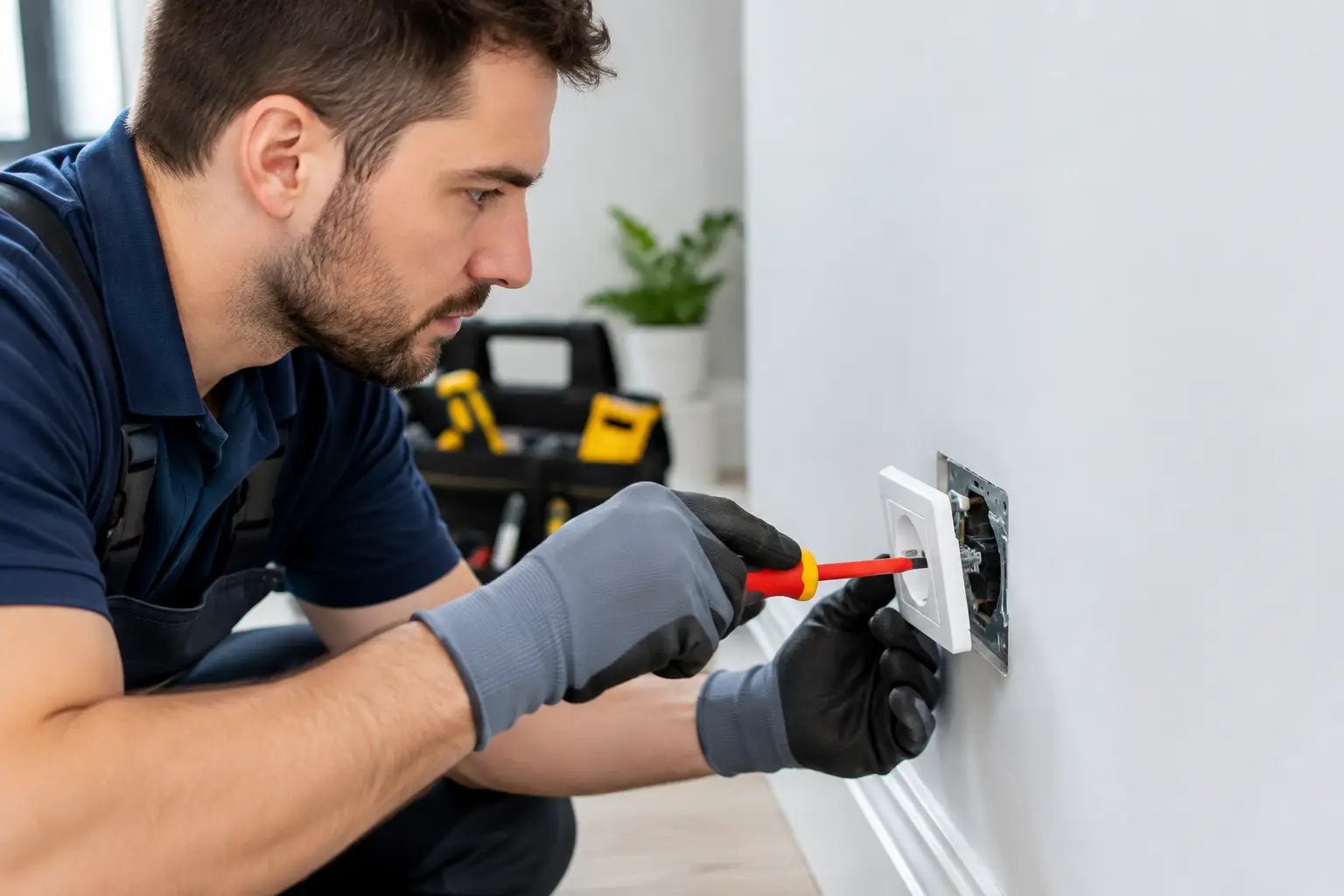
A socket that suddenly stops working is more than an inconvenience when it takes out the router, freezer, television or the only convenient charging point in a room. For dead socket repair Milton Keynes householders can rely on, the first job is not guessing or fitting a new faceplate. It is finding out why that point has lost power and making sure the rest of the circuit is safe.
A dead socket can be a small, contained fault. It can also be the first visible sign of a loose connection, damaged cable or issue elsewhere on the circuit. I diagnose the cause before recommending a repair, explain what I have found in plain English and leave the area tidy when the job is done. Small jobs are welcome.
What to do when a socket has no power
Start by checking whether the plug-in item works in another known-live socket. A failed charger, lamp or appliance can look exactly like a socket fault. If the item works elsewhere, try a different low-power item in the dead socket, such as a lamp, but do not repeatedly test it with appliances that draw a lot of power.
Next, look at your consumer unit. A tripped RCD, RCBO or circuit breaker may have caused sockets in one part of the home to go off. If a device has clearly tripped, switch off and unplug appliances on the affected circuit before resetting it once. If it stays on, reconnect items one at a time. The appliance or lead that makes it trip again may be the problem.
If the breaker will not reset, trips again straight away, or no protective device appears to have tripped, stop there. Do not take the socket apart, remove the front plate or try to bridge a connection. Electrical faults are not always visible from the front of an accessory, and opening it can expose live parts or worsen a damaged connection.
If you notice a burning smell, heat, buzzing, cracking, scorch marks or a loose socket face, turn off the relevant circuit at the consumer unit if it is safe to do so. Keep the socket out of use and arrange an electrician promptly. Those signs need proper attention rather than a quick replacement.
Why sockets stop working
The obvious culprit is sometimes the socket itself. Internal contacts can wear, terminals can loosen over time, and older or damaged accessories can fail. Replacing a faulty socket is often straightforward, but only after testing confirms that power and a sound earth are present at the point.
More often, the issue lies before the socket. Many homes have socket circuits that run between several outlets. A loose or failed connection at one socket can interrupt power to the next one, meaning the socket that appears dead may not be where the fault started. This is particularly common where sockets have been changed previously, furniture has pulled on plugs, or an older connection has deteriorated.
A damaged cable is another possibility. It might have been affected by drilling, nailing, DIY work or a historic alteration. A spur circuit may also have a fault at its connection point. In some properties, especially those extended or altered over the years, the layout is not immediately obvious. That is why a sensible dead socket repair in Milton Keynes is based on test results, not assumptions.
There is also a difference between one dead socket and partial power loss across a room or floor. If several sockets are out, the fault may be on the circuit itself, at a junction, or at the consumer unit. If lights are flickering as well, or another circuit is affected, it is worth treating the situation with more urgency.
How I find the fault properly
When I attend, I begin by listening to what happened. Did the socket stop after an appliance was used? Has decorating, drilling or furniture moving taken place? Are other sockets nearby still working? These details can save time, but they do not replace electrical testing.
I then safely test the affected socket and the circuit. Depending on the symptoms, this can include checks for voltage, polarity, earth continuity, insulation resistance and the continuity of the circuit conductors. I may need to inspect nearby sockets or relevant connections to trace where the supply has been lost.
That process matters because fitting a new socket to a dead cable does not repair anything. Equally, simply resetting a breaker without identifying why it tripped can leave an underlying fault waiting to return. The aim is to locate the cause, repair the defective part and verify that the circuit is operating safely afterwards.
Sometimes the repair is a replacement socket or a tightened and remade connection. Sometimes a damaged section of cable or an unsuitable previous alteration needs more work. I will explain the options before proceeding, including where the right repair involves testing more of the circuit rather than doing the fastest-looking fix.
When a dead socket needs urgent attention
Not every failed socket is an emergency, but some symptoms should not be left for later. Arrange prompt help if the socket is hot, discoloured, loose, making noise or smells of burning. The same applies if you receive an electric shock or tingling sensation from an accessory, a circuit will not stay on, or sockets are failing intermittently.
Intermittent faults deserve particular care. A socket that works when a plug is held in a certain position, or cuts out when a nearby switch or appliance is used, may have a poor connection. Loose connections can generate heat under load, so it is better to stop using the point than wait for it to fail completely.
For landlords and letting agents, a dead socket should be dealt with quickly even when tenants have other outlets available. It may affect a required appliance, expose a wider circuit issue or raise a concern during an electrical safety check. Clear fault diagnosis also helps avoid replacing the wrong item and returning for the same problem later.
Avoid the common quick fixes
Extension leads can be useful as a short-term measure, but they are not a permanent answer to a failed fixed socket. Avoid running leads under carpets, through doorways or across busy walkways. Do not overload an extension lead to make up for lost outlets, especially with heaters, kettles, tumble dryers or other high-load appliances.
It is also tempting to buy a replacement accessory and change it yourself. The trouble is that a socket can look simple while its circuit arrangement is not. Incorrect connections, loose terminals and missing earth continuity can create a serious hazard. A new faceplate may hide the symptom without dealing with the fault behind it.
If you are unsure whether the issue is the appliance, the socket or the circuit, a photo of the consumer unit and a brief description of what is and is not working can be useful when you get in touch. I can often give sensible initial guidance from the symptoms, then arrange a visit where testing is needed.
A repair that leaves you confident to use the room again
The useful outcome is not merely seeing a socket light up on a tester. It is knowing why it failed, what was repaired and whether there is anything sensible to keep an eye on. With more than 20 years of experience, I keep the explanation straightforward and do not treat a small fault as too small to investigate properly.
If a socket has stopped working in Milton Keynes, Woburn Sands, Bletchley, Newport Pagnell, Leighton Buzzard or a nearby village, keep it out of use where there are warning signs and get the cause checked. A properly repaired socket lets you get back to normal without wondering what is happening behind the wall.