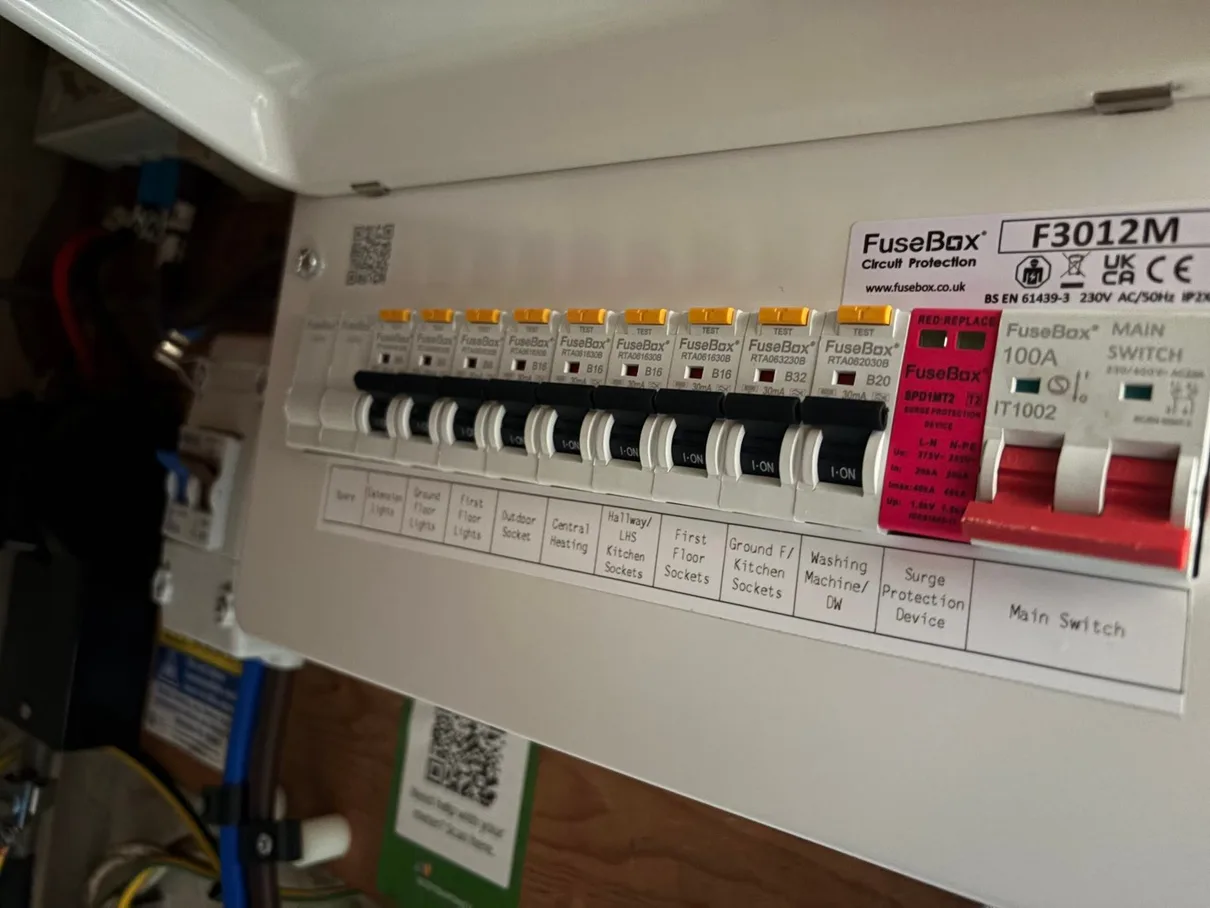
If your RCD keeps tripping, it can be frustrating — particularly when there seems to be no obvious reason for it.
The important thing to remember is that an RCD is a safety device. If it repeatedly switches off, it is usually detecting something that needs investigating rather than simply being a nuisance.
Common causes include a faulty appliance, moisture getting into electrical equipment, damaged wiring or an electrical fault somewhere on the installation.
What is an RCD?
An RCD, or Residual Current Device, is normally found inside your consumer unit — often still called the fuse box.
Its job is to monitor electricity flowing through the installation and disconnect the supply if it detects current flowing where it shouldn't.
This provides important additional protection against electric shock.
Many homes have one or more RCDs protecting several circuits. More modern consumer units may instead use individual RCBOs, which provide both residual-current and overcurrent protection for individual circuits.
Why does an RCD trip?
There isn't one single cause.
A tripping RCD tells us that something isn't right, but electrical testing is often needed to establish exactly where the problem is.
Some of the more common causes include:
A faulty appliance
An appliance can develop an electrical fault that causes leakage to earth.
Washing machines, dishwashers, kettles, ovens, fridges, freezers and other appliances can all develop faults over time.
Sometimes the RCD only trips when a particular appliance is switched on or reaches a certain stage of its operating cycle.
Water or moisture
Outside sockets, garden lighting, garages and outdoor electrical equipment are particularly exposed to damp conditions.
A damaged seal or fitting can allow moisture to enter and cause intermittent RCD tripping.
This is one reason electrical faults sometimes seem to appear after heavy rain.
Damaged wiring
A cable can become damaged through age, building work, fixings, pests or general deterioration.
These faults aren't necessarily visible and may require electrical test equipment to locate.
Fixed electrical equipment
The problem isn't always something plugged into a socket.
Cookers, immersion heaters, boilers, electric showers, outside lighting and other fixed equipment can develop faults that cause an RCD to operate.
More than one source of earth leakage
Modern homes contain a lot of electronic equipment.
Sometimes several items each contribute a small amount of earth leakage. Individually they may not cause a problem, but together they can contribute to an RCD operating.
Again, proper testing is needed rather than assuming the RCD itself is faulty.
What can I safely check myself?
You shouldn't remove the consumer unit cover or dismantle sockets, switches or electrical equipment.
However, if the problem appears to be associated with plug-in appliances, there is a simple observation you can make.
Unplug accessible appliances supplied by the affected sockets and try resetting the RCD once.
If it stays on, appliances can be reconnected one at a time.
If reconnecting a particular appliance causes the RCD to trip again, stop using that appliance until it has been checked or replaced.
If the RCD won't reset, trips again with appliances disconnected, or you can't identify an obvious cause, it's time to have the fault investigated.
Don't repeatedly reset an RCD that continues to trip.
Why does my RCD trip randomly?
Intermittent faults are common and can be some of the more difficult electrical problems to diagnose.
The RCD may stay on for hours or even days before operating again.
The cause could depend on:
- an appliance heating up or starting a particular cycle
- damp or changing weather conditions
- outside electrical equipment
- heating or hot-water controls switching on
- a developing cable or insulation fault
- several pieces of equipment operating at the same time
The fact that the RCD resets successfully doesn't necessarily mean the underlying fault has disappeared.
Intermittent faults often require systematic electrical testing to narrow down the circuit and eventually the cause.
My RCD won't reset at all
If the RCD immediately switches off again or won't stay in the ON position, don't keep forcing or repeatedly resetting it.
There may be a persistent fault on the installation or on equipment connected to it.
An electrician can isolate circuits and carry out tests to determine whether the problem is associated with an appliance, fixed equipment, wiring or the protective device itself.
Is a tripping RCD dangerous?
The RCD operating is itself a protective action.
The concern is why it is operating.
Repeated tripping can indicate an electrical fault, so simply resetting it every time without investigating the cause isn't a good solution.
If you notice burning smells, heat, scorching, crackling or signs of damaged electrical equipment, stop using the affected equipment and arrange for the problem to be checked.
How does an electrician find an RCD fault?
Electrical fault finding is a process of narrowing the problem down rather than guessing and replacing parts.
Depending on the fault, testing might include checking individual circuits, insulation resistance, protective devices and connected equipment.
Once the affected circuit has been identified, testing can become progressively more focused until the source of the problem is found.
Intermittent faults can take longer because the fault may not be present continuously.
RCD keeps tripping in Milton Keynes?
If your RCD keeps tripping and you can't identify the cause, JSC Electrical provides electrical fault finding and repairs across Milton Keynes and surrounding areas.
Rather than repeatedly resetting the trip switch or replacing components without knowing the cause, the aim is to test the installation systematically and find out what's actually wrong.
If you're experiencing repeated RCD tripping, loss of power or another electrical fault, get in touch with JSC Electrical to arrange a visit.