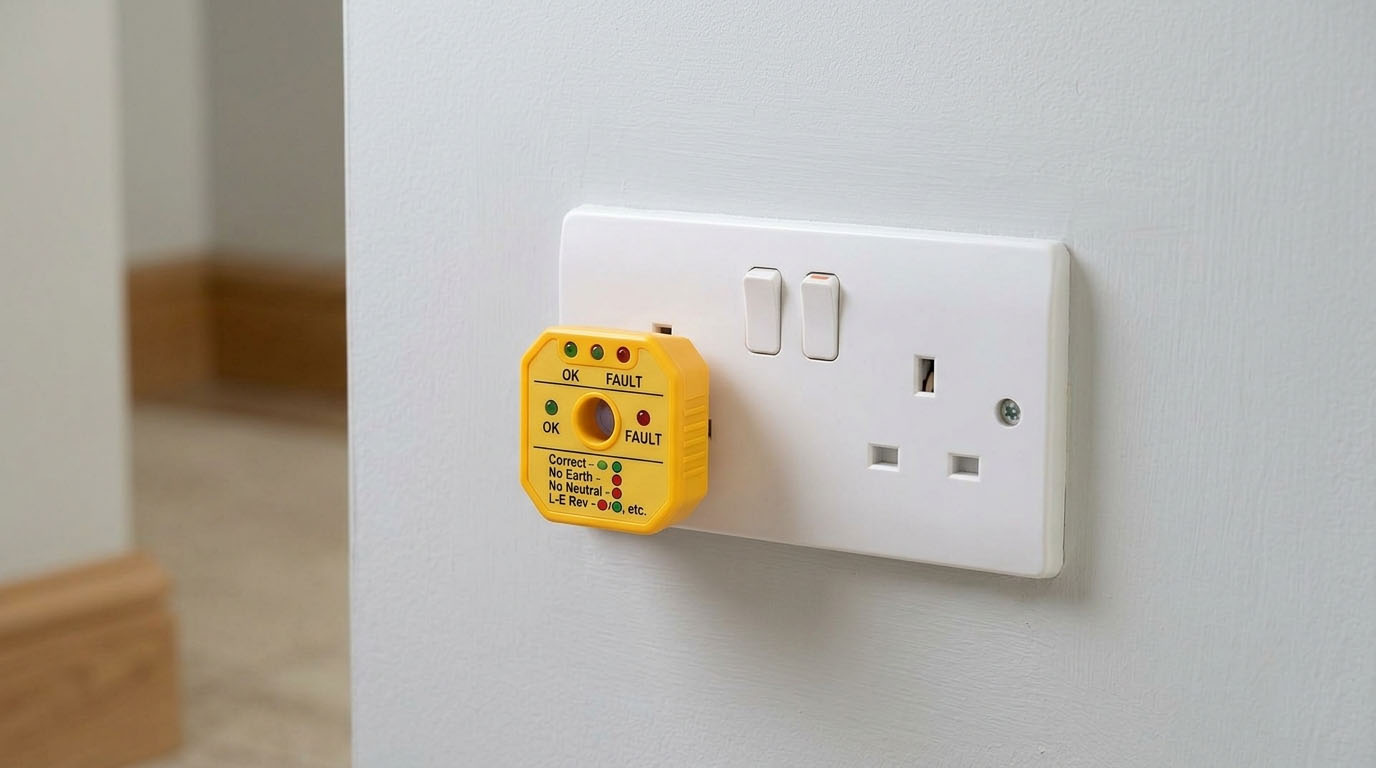
If you've found yourself asking “Why have my sockets stopped working?”, you're not alone — it's one of the most common things homeowners in Milton Keynes ask me about. The good news is that it usually has a clear cause, and some of the checks are completely safe to do yourself.
Below I've explained what normally causes it, what you can safely look at, and the point where it's time to get an electrician to test it properly.
What usually causes it
In most homes it comes down to one of a handful of things:
- A faulty appliance — kettles, washing machines, outdoor lights and older extension leads are frequent culprits.
- Moisture — water getting into an outside socket, a bathroom fitting or a junction box.
- Damaged cable or accessories — a nail through a cable, a cracked socket or a scorched plug.
- Loose connections — these can cause intermittent faults, warm accessories or flickering.
- An ageing installation — older wiring and consumer units can struggle with modern loads.
Sometimes it's a combination of these — for example, an outside socket that lets in a little water and only causes problems after heavy rain.
Is it an appliance or the installation?
The pattern usually tells you a lot. If the problem only happens when one particular item is switched on, the appliance is the most likely cause. If it happens at random, in wet weather, or on a circuit with nothing plugged in, the fault is more likely to be in the wiring, an accessory or something outside.
It also helps to know which device switched off. An RCD reacts to current leaking to earth — typically moisture or damaged insulation. A circuit breaker (MCB) reacts to too much current, such as an overload or a short circuit. Noting which one tripped is useful information for an electrician.
What you can safely check yourself
These checks don't involve opening anything up or touching wiring:
- Note when it happens — at a certain time, when it rains, or when a particular appliance is switched on.
- Unplug appliances on the affected circuit, then plug them back in one at a time to see if one triggers the problem.
- Look for visible signs — scorch marks, a burning smell, warm sockets or crackling. If you find any of these, stop and call an electrician.
- Check whether it's one circuit or the whole house, so you can describe it clearly.
- Reset a tripped switch once. If it won't stay on, leave it off.
Please don't remove socket faceplates, open the consumer unit or try to repair fixed wiring. Apart from the risk of shock, it often makes the fault harder to find.
When to call an electrician
Get it looked at if the problem keeps coming back, you can't isolate it to one appliance, anything feels hot or smells of burning, or a circuit won't reset. Those are signs of a fault in the installation rather than a plug-in item.
What an electrician will do
A proper fault-finding visit starts with isolating the affected circuit and testing it, rather than guessing. That usually means insulation resistance testing to find leakage or damage, checking connections at accessories, and testing any RCD protection to make sure it trips when it should.
Once the cause is found, you should get a clear explanation and a price for the repair before any further work starts.
Help in Milton Keynes
If an RCD, socket or circuit is playing up, I can test it, find the cause and repair it properly. I cover Milton Keynes and the surrounding villages, and you can call, WhatsApp a photo or request a callback.